Editor's Note
In his keynote address at the opening ceremony of the Global Leaders' Meeting on Women, held in Beijing on October 13, 2025, Chinese President Xi Jinping announced a series of measures China will take, in the next five years, to further support the global cause of women. One of the measures is: China will launch 1,000 "small and beautiful" livelihood programs with Chinese assistance that take women and girls as priority beneficiaries.
In recent years, numerous "small and beautiful" programs launched by China have taken root worldwide, playing a significant role in advancing economic and social progress in various countries, and in enhancing people-to-people connectivity.
|
| Click the video to hear the heartfelt voices of women benefiting from Juncao technology |
Juncao ("Jun" means "mushroom" and "cao" means "grass" in Chinese), a technology originated from China, has benefited the world. It is a successful exploration in China's poverty alleviation efforts and China's important contribution to global sustainable development. During the past more than two decades, with the personal attention and promotion of Chinese President Xi Jinping, this handy and practical technology, with its fast and remarkable effects on people's livelihood, has taken root in 100-plus countries, recording moving stories of how the technology helped lift people out of poverty and brought them hope and a better life.
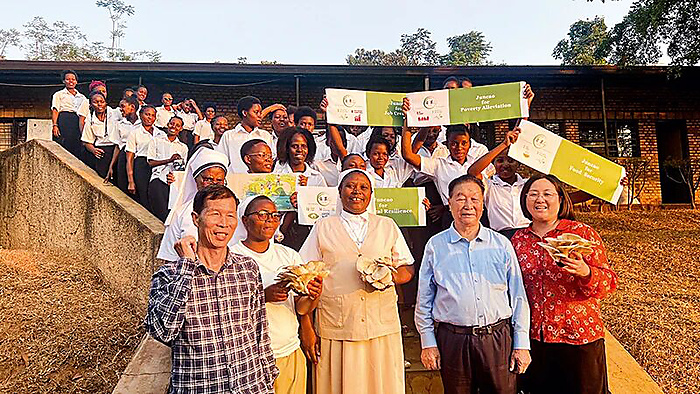 |
| Lin Zhanxi (front, second from right) and Lin Dongmei (front, first from right) in Rwanda, in 2024 |
Juncao technology was developed by Prof. Lin Zhanxi, Chief Scientist of National Engineering Research Center of Juncao Technology at Fujian Agriculture and Forestry University (FAFU, in Fuzhou, capital of southeast China's Fujian Province), in 1986. Since then, the technology has spread from Fujian to other regions of China, and then to other countries. Lin's daughter, Dr. Lin Dongmei, has traveled to Africa 38 times since 2004. She has adapted the Juncao technology to the local conditions in the African countries, and helped impoverished African women escape poverty and harvest happiness.
'Grass of Happiness, Grass of Prosperity'
Juncao technology — a grass used to cultivate edible mushrooms, feed livestock, and prevent soil erosion, contributes economic, social and environmental benefits, and it helps improve ecology and food and energy security. It yields quick results at a low cost. Juncao has become a "Grass of Happiness" and "Grass of Prosperity" for people in developing countries.
Lin Zhanxi, inventor of Juncao technology, is known as the "Father of Juncao."
Lin Dongmei began working with her father in 2003. Initally, she helped her father compile teaching materials, conduct research and translate documents. Gradually, she came to understand her father's perseverance, and the significance of his work, that his work was not just about technology transfer, but rather a commitment to the world. Lin Dongmei has followed her father's philosophy of international assistance through Juncao. While adhering to a woman's perspective, she has taught African women various skills, such as methods to grow Juncao grass and mushrooms. She has helped African women escape poverty, and she has formed deep friendships with women across Africa. "They call me the 'Daughter of Juncao,'" Lin Dongmei says.
She now serves as Vice Dean of International Juncao College, at FAFU, Deputy Director of the China National Engineering Research Center of Juncao Technology, and as a consultant for the United Nations Juncao Project. Lin Dongmei has more than 20 years of experience in leading Juncao research, teaching Juncao Science, and working on related social services and international cooperation projects. She was named a National March 8th Red-Banner Holder in 2024.
Sparking Hope
Lin Dongmei first traveled to Africa in 2004, when she accompanied her father to KwaZulu-Natal Province, in South Africa, to promote Juncao technology. In 2005, while working in KwaZulu-Natal, she encountered several local, single mothers who were "the poorest of the poor." Those women had no land, no education and they were barely making a living.
Lin Dongmei wondered how the landless, uneducated women would be able to master Juncao technology? She and her team simplified and localized the technology, creating a "10-square-meter mushroom farm" model for the women. The team broke down each production step, and they developed the simplest, most suitable local methods; for example, they provided ready-made, mushroom substrate bags and buckets, they explained when and how to water the mushrooms, and they helped the women sell the mushrooms. From planting to harvest, the quickest mushroom-growth cycle took just seven days.
A 10-square-meter mushroom farm was capable of producing 1.2 tons of fresh mushrooms annually, generating US $2,400 in income, or triple what the single mothers would normally earn. As she watched the African women increase their incomes, and improve their families' lives by growing mushroom, Lin Dongmei came to understand the true value of international assistance through Juncao technology. She realized the technology could ignite the spark of hope, and that it could also change people's future.
Teaching How to Fish
With the launch of the Belt and Road Initiative, Lin Dongmei set an even loftier goal: To implement Juncao technology in more impoverished countries and regions. She believes it is vitally important to help people in recipient communities foster sustainable development.
To scale up the technology effectively, Lin Dongmei created an extension model for developing countries: "Juncao demonstration centers/bases + flagship sites (farmers' associations/cooperatives) + individual farmers," which she has since used to mobilize impoverished women to adopt Juncao production and lift themselves out of poverty. She has also provided scholarships and international training programs to young women and farmers across numerous countries.
In June 2023, Lin Dongmei was invited to deliver the keynote speech during the China-Africa Women's Forum, in central China's Hunan Province. She shared the story of Freda Korarome from Papua New Guinea, who used Juncao technology to transform her life. With the help of Chinese experts, Freda evolved from a poor, rural woman into a pioneer in Juncao cultivation. She has since built her own house, bought a car and started her own Juncao farm. Her farm produces 200 kilograms of fresh mushrooms per week, and it provides jobs to 25 farmers, most of whom are women. Freda has shared the technology with farmers in 10 neighboring villages, and, with Chinese experts, she has helped train 1,500 women, youth and people with disabilities.
During the past two decades, the Juncao research team, led by Lin Zhanxi and Lin Dongmei, has trained more than 8,000 people in 45 African countries. Demonstration bases and sites have been established in Rwanda, the Central African Republic, Lesotho, South Africa, Madagascar, Nigeria, Tanzania and Zimbabwe to spread Juncao technology. Worldwide, more than 18,000 participants have received training in Juncao technology, with introductory materials on the technology available in 18 languages for ongoing global dissemination.
Practical Juncao-aid initiatives have brought tangible development opportunities to women in different circumstances, and those initiatives have helped protect the women's right to development. For example, the "10-square-meter mushroom farms," in South Africa have helped many single mothers escape extreme poverty, and gain financial independence. The "one-hectare Juncao pastures," in Tanzania have empowered women farmers grow into entrepreneurs, and boosted women's employment opportunities. Some physically challenged women in Fiji have achieved self-sufficiency through Juncao mushroom cultivation, earning the respect from their communities. Some women in the Central African Republic found renewed hope amid war after adopting Juncao technology.
Green Power for Women
"Juncao projects start with technical empowerment, equipping women with practical skills. These translated into economic empowerment by helping them generate a stable income. Finally, they lead to social empowerment by enabling women to step out of the domestic life to participate in public affairs, gaining greater respect and a voice," Lin Dongmei said, during a speech, entitled "Juncao For She — Green Power for Women in the Global South," during the Women Power Forum, in Hong Kong, on April 1, 2026.
During the forum, Lin Dongmei explained how her team not only provided development opportunities to African women, but also supported local women farmers to speak at the United Nations, ensuring the voices of women from the Global South were heard worldwide.
When asked for her view of the future, Lin Dongmei says Juncao technology will continue to serve the global cause of women's development. She vows her team will scale up systematic Juncao-cultivation training for women in developing countries, to foster the training and nurturing of local leaders and large numbers of women technical experts.
The team will also develop more small-scale, Juncao-production models to help women generate incomes near their homes, secure their economic independence and improve nutrition in their households.
Lin Dongmei also vows her team will offer Juncao scholarships to women international students, cultivate scientific talents, provide Juncao Science materials to schools and enhance girls' scientific literacy. The team will also use the technology to build bridges of mutual understanding, continuously empower women's independent development, help narrow gender-development gaps, and support global women's development through livelihood support, skills enhancement and industrial empowerment.
"With the resilience of Juncao, rooted firmly in the soil, we will move forward, with determination. With the strength of women, linked by a shared future, we will strive for common development," Lin Dongmei says. She also wants to work with more women, around the world, to ensure this "Grass of Happiness" flourishes in more places, and to ensure Chinese women and women throughout the world write a new chapter of win-win cooperation and of shared development.
Photos and Video from China National Engineering Research Center of Juncao Technology
(Women of China English Monthly June 2026)
Editor: Wang Shasha
