Food, especially China's cuisine industry, has become an integral component of cultural exchanges, which are being increasingly used to break barriers caused by different languages and cultural backgrounds. In recent years, an increasing number of Chinese women chefs, especially young chefs, have stood out on the world stage. They have shown the world their excellent cooking skills, and their innovative ideas for cuisine development. More importantly, they have presented Chinese women's wisdom and strength as they have promoted Chinese cuisine and culture in the new era.
Women of China highlights several stories involving Chinese women who have smartly combined the concepts and techniques of Chinese cuisine with food that is popular worldwide. The women have been leaving their marks on cultural exchanges, and those marks have helped advance the creative and vigorous global food culture. In this article, we share the story of Qu Yuyu, a young chef born in 1996.
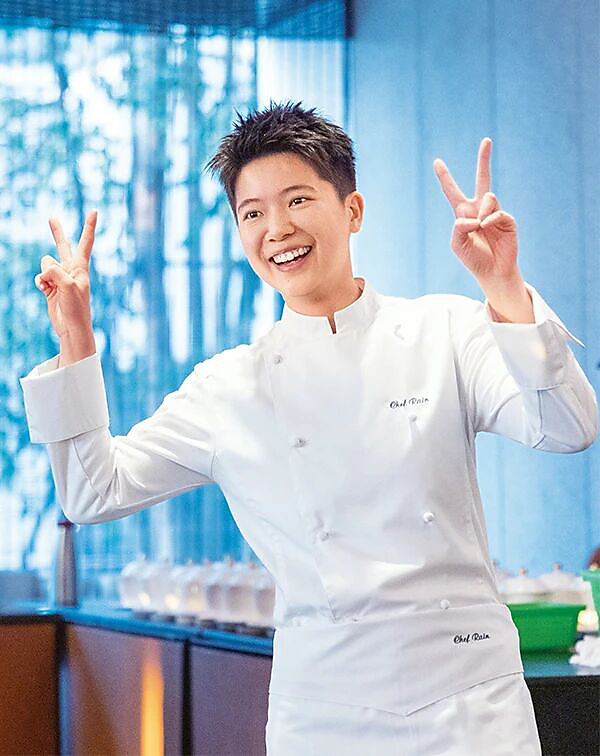 |
Qu Yuyu, a young chef born in 1996 |
Chef of China, a cooking competition that premiered on Tencent Video, became a hit during the summer of 2025. The show united a dazzlingly diverse cast of culinary talent in China. Qu Yuyu, or Chef Rain, a young woman born in 1996, won the competition.
Qu's dream to become a chef began to sprout when she was 12, after she saw flames leaping from a grill in a restaurant. As she watched the chef flip the ingredients, amid the flames, Qu thought, for the first time, that cooking was the coolest profession in the world.
In high school, Qu kept asking herself: "If I'm going to spend time on something, why not learn what I love?"
In 2013, Qu began studying at a culinary school in Panyu, in Guangzhou, capital of south China's Guangdong Province. She worked hard, learned the cooking skills and, nine months later, she graduated and found a job at a light-food restaurant. She was assigned to work in the cold kitchen, mainly working with lettuce and salad dressing every day. She longed to stand in front of the stove, in the hot kitchen, but she knew the hot kitchens were typically man-dominated domains, as they tend to be more psychically demanding.
A few years later, Qu found a job at a five-star hotel, in Shenzhen (also in Guangdong). She was given the opportunity to work in the hot kitchen. "Back then, many people wouldn't easily entrust women chefs with important tasks," Qu recalls. Instead of complaining, she worked hard to prove herself. She arrived early every day, took the initiative to help colleagues prepare ingredients, and she carried a small notebook to record her mentor's instructions. She used leftover vegetable peels and raw rice to practice flipping ingredients in the woks. She repeated the flipping motion until she developed tenosynovitis in her wrist, which eventually formed muscle memory. Gradually, her colleagues recognized her ability. One day, the head chef said, "From now on, if there are girls like Qu, please introduce them to my restaurant." At that moment, Qu knew she had broken the gender bias, through her strength.
Qu made a decision in 2019 that surprised her friends and family; she decided to quit her job to join a catering company, in Guangzhou, that specialized in outdoor banquets. Her decision ran against conventional wisdom, as industry insiders generally did not consider outdoor banquets to be "orthodox." Why? There's no fixed restaurant, no chance to participate in the Michelin Guide selection and the working environment is full of variables. However, the uncertainty of outdoor banquets helped Qu hone her ability to think on her feet.
At one banquet, a guest brought along a friend who was an ovo-lacto vegetarian, but all dishes had been cooked following the original menu (containing meat). Qu had an idea; she used the remaining zucchini, water chestnuts, bamboo shoots and eggs to stir-fry scrambled eggs, and then stuff the eggs into "woven bags" made from zucchini strips. This impromptu dish later became the inspiration for her stunning "Tomato and Egg Woven Bag," which she prepared during the final of Chef of China.
Cooking on the stage of Chef of China became a turning point in Qu's life. During the final, she wowed everyone with a set of "egg dishes," including the above-mentioned creative "Tomato and Egg Woven Bag." The other egg dish, "Ginger Egg Rice Ice Cream," showed viewers — and the judges — her deep understanding of ingredients. When the host announced she was the champion, Qu, who rarely ever cried, let loose a flood of long-suppressed tears.
Qu has been incredibly busy since the show aired. She has flown to three cities a week, as a routine, and she has been busy collaborating with other chefs on banquets and developing new menus for outdoor banquets. Every time she arrives in a new city, the first place Qu goes is the local market. She becomes excited when she sees fruits and vegetables she has never seen before. Qu believes true flavors must be tested with one's own hands; only when you touch, cut and cook an ingredient can you truly understand it.
Qu's kitchen continues to expand, from restaurant backyards to deserts, grasslands and forests. Her dishes are not only a feast for the taste buds, but also carriers of culture. She works to integrate Western ingredients with Chinese culture and to share Chinese cuisine with more international guests. For example, Qu created a dish, "Xiangxi Smoked Beef Short Ribs with Spicy Mousses," which is served in a customized box. The box is decorated with traditional window paper-cut patterns from Xiguan (a culturally significant historical district in Guangdong).
Qu has grown from a vocational-school student to a highly acclaimed star chef. She knows that breaking stereotypes in the kitchen is not the end, but a new beginning. In the future, she wants to bring Chinese culinary philosophy to the world, so more people can see the faces of Chinese chefs.
Photos from Interviewee
(Women of China English Monthly February 2026)
Editor: Wang Shasha
