Xiong Rong, a Qiushi Distinguished Professor with Zhejiang University, and Chief Scientist with Zhejiang Humanoid Robot Innovation Center, received the International Federation of Robotics (IFR) "Women Shaping the Future of Robotics 2026" Award in March. The award, which recognizes 11 outstanding women scientists worldwide each year, is among the most-prestigious honors for women in robotics. Xiong was the only recipient from China this year.
Xiong has been dedicating herself to robotics technology for nearly three decades. She has led her team in developing robotic intelligent sensing-and-control technology, promoting commercial application of humanoid robots, and building collaboration and talent-cultivation platforms within the robotics industry.
With wisdom, courage and tenacity, Xiong constantly reflects to the world a Chinese woman scientist's strength in helping China's robotics technology excel in various technological competitions, and achieve both technological self-reliance and industrial application.
Start, from Trials
Xiong developed her interest in engineering at an early age. When she was in middle school, she tried computer programming during one of her summer vacations. She was fascinated by the process of running a computer, especially designing and delivering instructions to the machine. A few years later, she wrote the college-entrance exams, and she chose to study computer hardware at Zhejiang University (ZJU), in east China's Zhejiang Province.
During her third year of undergraduate studies, Xiong was recruited to work in the laboratory led by Ye Chengqing, a renowned professor in ZJU's computer department. There, Xiong formed the habit of conducting trials while simultaneously studying.
She began working in industrial-control technology, in a key national laboratory, established at ZJU in 1997. She was primarily responsible for the administration of email servers, the construction of lab websites and the collection and maintenance of technological files. In addition to completing her daily tasks, Xiong often involved herself in various research programs launched by her colleagues' teams.
A turning point in Xiong's career came in 2000, when the laboratory began planning the research and development of intelligent robots. Xiong posted a recruitment message on ZJU's BBS (Bulletin Board System). She then screened applicants and formed a small, four-member team. After one year of continuous designs, evaluations and testing, her team developed ZJU's first-generation, FIRA soccer robot. That accomplishment laid the foundation for future breakthroughs.
As core supervisor of ZJUNlict, ZJU's small-size-robot soccer team, Xiong witnessed how the robots, developed by her team and her university, performed excellently in world competitions. In June 2013, ZJUNlict won its first world championship, in the Small Size League, during the Robot World Cup (RoboCup), in Holland. The next year, ZJUNlict defended its RoboCup championship, helping the robot team, developed by ZJU, reach the forefront of global competition.
Meeting Real-World Needs
Xiong readily understood if robot relied on instructions, delivered by computers, and in a certain environment, it was essentially about "technology applied in a laboratory." She hoped to develop robots that would be able to sense various environments, and then be able to make reactive decisions based on real-world circumstances.
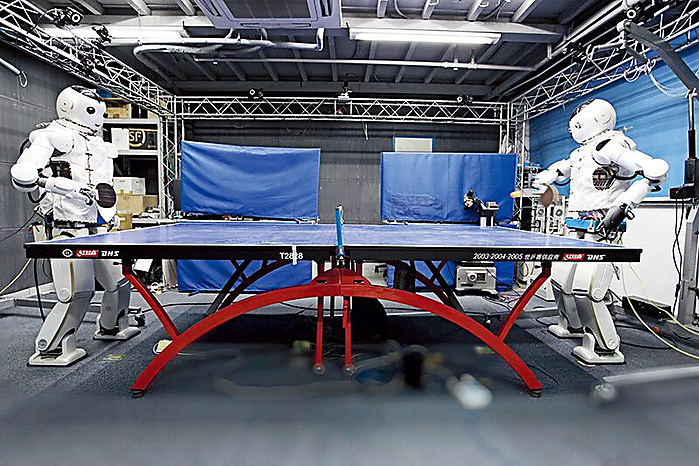
In 2011, after more than four years of research, Xiong's team developed "Wu" and "Kong" — two humanoid robots capable of demonstrating table tennis rallies. With 30 joints, and seven degrees of freedom in each arm, the robots generated widespread attention, worldwide, and, more importantly, marked a milestone in the evolution of humanoid robotics.
For Xiong, robotics must transcend a laboratory and serve real-world needs. With that belief, she promoted the industrial application of robotics technologies. In 2023, in response to the rapid rise of embodied intelligence, Xiong established Zhejiang Humanoid Robot Innovation Center. As humanoid robots represent the best carrier of embodied intelligence, Xiong led her team in launching the "Navigator" series of humanoid robots. "Navigator No. 2 NAVIAI" became the first humanoid robot developed by Xiong's team capable of completing precise work tasks in various sectors, including industry, service, education and data collection.
From soccer-playing robots, to mobile robots, then to humanoid robots, Xiong has adhered to her research philosophy of "making technology acquirable and more usable." She looks forward to witnessing humanoid robots being applied in the domestic-service and nursing-care sectors.
 |
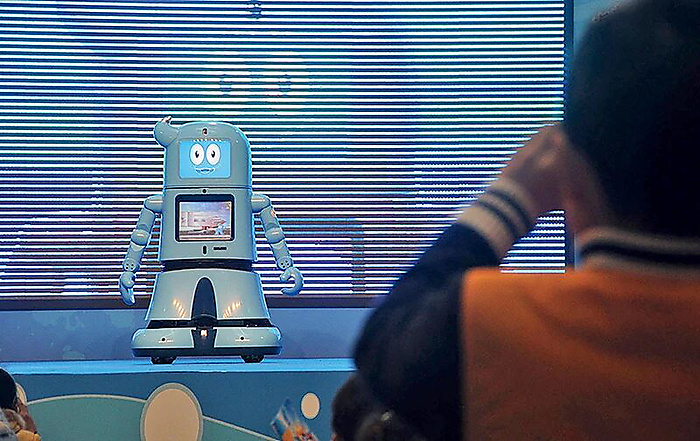 |
| The humanoid table-tennis-playing robots (in the left photo) and the Haibao intelligent service robot (in the right photo), both designed by Xiong Rong's team |
Leading the Way
As a professor with the university for more than two decades, Xiong has been leading the way so numerous students can enter the field of robotics. In addition to teaching knowledge and skills, Xiong has been paying attention to inspiring the students' interests in robotics.
For the discussion sessions, for her new students, Xiong sets four themes: Robot and Human, Robot and Society, Robot Development, and Robot Design. The university also offers robot-manufacturing courses, during which standardized materials are provided so the students can make robots.
Xiong says she hopes her students not only know "how to learn," but also know "how to create." Since 2001, Xiong has helped build robotics-education platforms, launched competitions, and improved relevant courses at ZJU. Many of her former students have become influential figures in academia, and especially within the robotics industry.
As a woman scientist, Xiong always encourages young women to enter the field of engineering. When she received the IFR award, in March, she said she was proud to shine as a representative of Chinese women scientific and technological workers. "Robotics, and other engineering sectors, should never set gender-based barriers. Our persistence and passion matter the most," Xiong says.
Steady Efforts Ensure Long-Term Achievements
Xiong believes China has unique advantages to bring to the development of humanoid robots. The technologies developed by Chinese research teams have covered humanoid robots' movement control, human-machine mapping and robot intelligence. "We must rely on the manufacturing industry of our country to achieve breakthroughs in the manufacturing of core components of robots," Xiong notes.
Joint efforts, she adds, are necessary for the overall advancement of the robotics industry. In recent years, Xiong and her team have worked to build platforms that facilitate communications among research teams and institutions across China. For example, she led the establishment of a provincial humanoid robot industrial technology union in Zhejiang, and she collaborated with 100-plus higher-learning institutions, nationwide, to share resources and form an integrated industrial and educational network, specifically for the development of embodied intelligence. Xiong says laying a solid industrial foundation for younger generations to strive for achievements, over the long term, is the most important thing the current generation of researchers can do.
Photos from Interviewee and VCG
(Women of China English Monthly August 2026)
Editor: Wang Shasha
